

Make any holiday dinner or special occasion hard to forget with this restaurant-quality prime rib. A classic prime rib roast is seasoned with herbs and slow-roasted to perfection using a simple, foolproof method.

This post may contain affiliate links. Please read our disclosure policy.
Holly’s Recipe Highlights
- Flavor: Prime rib is rich and juicy with a tender bite in a simple herb and garlic crust that brings out the beefy flavor without stealing the spotlight.
- Technique: A high-heat sear in the oven then low-and-slow roasting keeps it juicy and evenly cooked.
- Prep Note: Bringing the roast to room temperature ensures even roasting from edge to center.
- Recommended Tools: A digital thermometer is the real hero here for perfect doneness. You’ll also need a roasting rack and some butcher’s twine!
- Time-Saving Tip: Ask the butcher to remove and tie the bones for you.

Ingredient Notes
- Prime Rib: Prime rib (AKA standing rib roast) is an exceptionally tender cut of beef from the central rib portion of the cow. Choose a well-marbled prime rib for the juiciest results.
- Oil: Use a neutral oil like vegetable oil to help the seasonings adhere. Butter isn’t the best choice to start, since the high heat can cause it to burn before the roast gets going.
- Garlic: Fresh garlic offers the best flavor and caramelizes nicely on the roast.
- Seasonings: Kosher salt seasons evenly. Use less if swapping in table salt. Fresh rosemary adds earthy brightness, but dried and crushed works too. Thyme brings gentle herbal flavor, and black pepper adds a little bite to balance the richness.


How to Cook Prime Rib
- Prep: Bring the roast to room temperature.
- Rub: Mix the seasonings, pat the roast dry, and coat it well.
- Roast: Start with a high-heat roast, then reduce the oven temperature and cook until the thermometer reaches your preferred doneness.
- Rest: Let the roast rest so the juices settle, then slice into thick, tender pieces.
For a darker crust, broil for 1 to 2 minutes after roasting if needed.

Holly’s Tips for a Perfect Roast
- Letting the roast come to room temperature before roasting helps it cook evenly from edge to center.
- Use a digital thermometer and rely on temperature, not time, (or guesswork!) for accuracy. There’s nothing more disappointing than a dried out prime rib roast, so make sure you have one on hand.
- Score the fat cap lightly so seasoning sticks and the crust forms evenly.
- Always rest the roast before slicing for maximum juiciness.
- Slice against the grain for the most tender bite.
Prime rib cooks at two temperatures: a high-heat sear at 475°F, then a lower-temperature roast at 300°F.
After the initial sear, estimate:
10–12 minutes per pound for rare
13–14 minutes per pound for medium-rare
14–15 minutes per pound for medium
Final resting temperature:
115 -120°F for rare
125 -130°F for medium rare
135 -140°F for medium
Always rely on internal temperature instead of time for accuracy.
Prime rib is typically served in thick slices, so the rule of thumb allows for ½ to ¾ pound per person.
To reheat prime rib so it stays pink and tender, first bring to room temperature, then place in a covered dish with a splash of broth and heat at 250°F for 10–20 minutes, until just heated through.
Store slices in airtight containers in the fridge for up to 4 days. Freeze cooked prime rib tightly wrapped or vacuum-sealed for up to 3 months. Reheat gently in a covered dish at a low temperature or briefly in a skillet with broth to keep it from drying out.
Prime rib can be repurposed for a multitude of recipes. You can cut into thin slices for tender French dip, Philly cheesesteak, or beef rouladen. It can also be cut into chunks for stew or beef stroganoff. Prime rib leftovers will make any recipe shine!
Perfect Sides for Prime Rib


Did you enjoy this Prime Rib Recipe? Leave a rating and comment below.

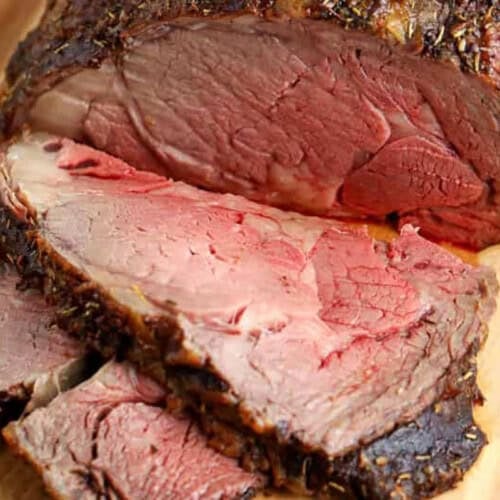

Prime Rib


Ingredients
- 5 to 7 pounds prime rib (3 ribs)
- 2 tablespoons vegetable oil or olive oil
- 4 cloves garlic minced
- 2 teaspoons kosher salt *
- 1 tablespoon chopped fresh rosemary or 1 teaspoon dried rosemary, crushed
- 1½ teaspoons fresh thyme leaves or ½ teaspoon dried thyme leaves
- ¾ teaspoon black pepper
Instructions
- Remove the roast from the refrigerator and let it rest at room temperature for 2 hours before cooking.
- Preheat the oven to 475°F.
- If your prime rib has the ribs (bones) attached, place it on a cutting board, bone side up. Using a sharp knife, cut along the bones to remove them from the meat, keeping the cut as close to the bones as possible.
- Set the roast on top of the bones where it was cut from and use kitchen twine to tie the bones securely to the roast, ensuring they are snug against the meat. Use a large knife to score the fat slightly at 1-inch intervals, about ⅛-inch deep.
- In a small bowl, combine the oil, garlic, salt, rosemary, thyme, and black pepper. Mix well.
- Pat the roast dry with paper towels and cover evenly with seasoning mix. Place roast fat-side up in a large roasting pan with the bones acting as a rack. If your prime rib is boneless, set it on a rack. Insert a digital meat thermometer into the center of the meat, away from the bone.
- Place the roasting pan in the oven and cook the prime rib uncovered for 15 minutes at 475°F. Without removing the roast or opening the oven, reduce the oven temperature to 300°F and continue cooking until the roast reaches an internal temperature of 120°F. (*See notes for cooking times.)
- Remove the roast from the oven and tent it with aluminum foil. Let it rest for 20 to 30 minutes or until the temperature reaches 125 to 130°F for medium rare. **See notes for cook times and desired doneness.
- Once rested, use kitchen scissors to cut the twine. Remove the roast from the bones and place it on a cutting board. Using a sharp knife, cut the roast into ¾-inch slices.
Notes
10 – 12 min per pound for rare
13 -14 min per pound for medium rare
14 – 15 min per pound for medium Final resting temperature
115 -120°F for rare
125 -130°F for medium rare
135 -140°F for medium Leftover prime rib will last in an airtight container in the refrigerator for up to 4 days.
Nutrition Information
Nutrition information provided is an estimate and will vary based on cooking methods and brands of ingredients used.
 Course Beef, Entree, Main Course
 Cuisine American
© SpendWithPennies.com. Content and photographs are copyright protected. Sharing of this recipe is both encouraged and appreciated. Copying and/or pasting full recipes to any social media is strictly prohibited. Please view my photo use policy here.


Adapted from Our Zesty Life Prime Rib Roast.


every recipe I have tried has been absolutely delicious, simple to make an ingredients that I have in my home. I give you two thumbs up you’re awesome.
Thank you so much, Diane! That is so kind of you to say.
very flavorful roast, the seasoning is just right. I used the kosher salt like the recipe called for. definitely going to make it again
So glad you loved it Jeff!
You are amazing because you are to the point in your recipes, they are easy to read, you don’t add extra information that usually bores, and you have me excited to try them. Thank you.
I’m so glad you’ve found the recipes and tips helpful! Let us know how it goes when you try them!
I cooked a prime rib for Easter and followed this recipe exactly. It was my first time cooking a roast prime rib. It came out perfectly and was beautiful!
I follow Holly’s recipes frequently and they are always wonderful.
So happy to hear that, Candy! I am glad it turned out so well for you!
why dioyou remove the ribs from the meat. Does that allow the meat to cook evenly. Thxs
It allows for easier serving. The bones are still tied to the meat and roasted along with the meat, they’re just easier to remove for serving.
why do you remove the bones? Roasting them with the meat and then making broth is heavenly!
We found removing the bones gave us the best results when serving this recipe. The bones are in fact trussed to the roast and cooked along with the meat, they’re just easier to remove and serve.
I agree with you Laura, never remove the bones. It’s a new Trend some cook started now all cooks copy this silly method. It’s hard to find a cook that remains original.
I’m not sure it’s a trend however, this is a method I’ve learned over the years and the results are always perfect. I do remove the bones and tie them back onto the meat so you still get the same results with easier carving and serving. You can certainly leave them intact if you prefer.
what an easy and delicious recipe. I followed this recipe and it was the first prime rib I cooked. I will do it again.
I’m so glad you loved it Mike!